It’s Me, Hi, I’m the Teacher, It’s Me: A Practical Guide to Custom Embroidery Workflows
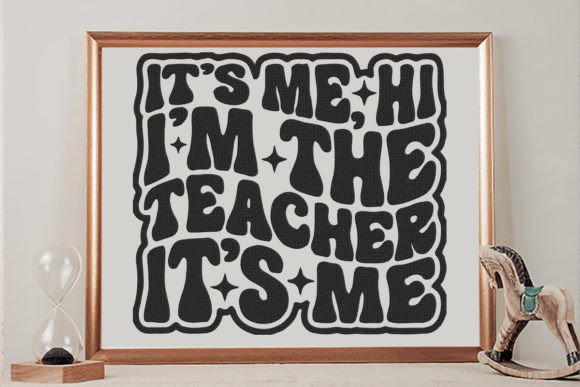
In the landscape of modern crafting and small business production, the transition from a digital concept to a tangible product relies heavily on the quality of your assets. One such asset that has gained significant traction for its charm and versatility is the machine embroidery design known as It’s Me, Hi, I’m the Teacher, It’s Me. This specific motif is not merely a decorative element; it serves as a functional tool for branding, personalization, and inventory differentiation. For educators, boutique owners, and home decor enthusiasts, integrating this design into a structured workflow can streamline production and enhance the perceived value of finished goods.
The phrase itself carries an inherent narrative. It captures the dual identity often embraced by teachers who balance professional duties with personal warmth. When translated into thread and fabric, it becomes a statement piece. However, the true utility of It’s Me, Hi, I’m the Teacher, It’s Me lies in how it fits into the broader process of textile creation. Whether you are preparing for back-to-school season, launching a new line of personalized gifts, or simply updating your home office, understanding the mechanics of using this design ensures efficiency and high-quality results.
Strategic Integration into Production Workflows
Effective use of any embroidery design begins before the needle ever touches the fabric. The planning phase is where the potential of It’s Me, Hi, I’m the Teacher, It’s Me is realized. In a professional setting, this involves selecting the right substrate—towels, pillowcases, tote bags, or wall hangings—and determining the optimal placement for maximum visual impact. Unlike freehand sketching, machine embroidery requires precise digitization and file management. The design comes with multiple embroidery file formats, which is a critical feature for compatibility across different hardware ecosystems.
Before starting a project, creators must assess their equipment capabilities. If you operate a single-brand machine, ensuring the correct file format is selected prevents time-consuming conversion errors. For those managing a diverse fleet of machines or collaborating with third-party manufacturers, having access to various formats allows for seamless scaling. This flexibility means that It’s Me, Hi, I’m the Teacher, It’s Me can be deployed immediately without the bottleneck of file conversion software, accelerating the timeline from order receipt to shipment.
During the execution phase, the design interacts directly with your stabilizers, threads, and tension settings. The whimsical nature of the text implies curves and potentially varied stitch densities. Proper preparation involves hooping the fabric securely and selecting a stabilizer that matches the weight of the material. For instance, embroidering this design on a plush towel requires a cut-away stabilizer to support the pile, whereas a cotton pillowcase might only need a tear-away option. Understanding these interactions prevents puckering and ensures the text remains legible and crisp.
Optimizing File Management and Compatibility
A common friction point in embroidery workflows is file incompatibility. The It’s Me, Hi, I’m the Teacher, It’s Me package addresses this by providing multiple standard formats. This feature supports a robust organizational strategy where files are categorized by machine type or project batch. By maintaining a library of pre-converted files, operators can reduce setup time significantly. This is particularly valuable during high-volume periods, such as the weeks leading up to the school year, when speed and consistency are paramount.
Furthermore, the ability to use the design across multiple platforms facilitates collaboration. If a designer creates a mock-up but the stitching is done by a production team, standardized file formats ensure that the vision remains intact. There is no loss of detail or distortion of the playful typography. This interoperability is essential for businesses that outsource certain aspects of their production while maintaining strict quality control standards.
Use Cases Across Different Sectors
The versatility of It’s Me, Hi, I’m the Teacher, It’s Me extends beyond simple decoration. It serves distinct purposes depending on the user's goals. For independent educators, this design offers a way to create branded merchandise that reinforces their classroom identity. Embroidered on tote bags or water bottles, it acts as a subtle marketing tool that travels with students and parents. The tactile nature of embroidery adds a layer of professionalism that screen printing often lacks.
In the realm of home decor, the design functions as a focal point for thematic rooms. Imagine a nursery or a home office where the owner values education and learning. Placing this motif on a throw pillow or a kitchen towel introduces a touch of whimsy and charm that aligns with the room's aesthetic. The process here shifts from mass production to bespoke customization, allowing the creator to tailor color schemes to match existing interior palettes. This adaptability makes the design a long-term asset rather than a one-off trend.
For small business owners specializing in gifts, the design opens up a niche market. Personalized teacher appreciation gifts are a consistent revenue stream. By integrating It’s Me, Hi, I’m the Teacher, It’s Me into a catalog of customizable items, entrepreneurs can offer unique products that stand out in a crowded marketplace. The key to success in this sector is the ability to produce consistent, high-quality items quickly. The multi-format availability of the design supports this by allowing rapid switching between machines to meet demand spikes.
Quality Control and Consistency Standards
Maintaining quality is non-negotiable in any production workflow. When working with text-heavy designs like It’s Me, Hi, I’m the Teacher, It’s Me, even minor tension issues can render the words illegible. Implementing a rigorous quality control check after every run is essential. This involves inspecting the stitch density, checking for skipped stitches, and ensuring the backing is removed cleanly without damaging the fabric.
Consistency also applies to color matching. If producing a batch of items, using the same thread brand and lot number ensures that the shade of red or blue remains identical across all pieces. This attention to detail builds trust with customers and establishes a reputation for reliability. Over time, these practices contribute to a streamlined operation where defects are minimized, and rework is virtually eliminated.
Long-Term Implementation and Asset Utilization
From a strategic perspective, acquiring a design like It’s Me, Hi, I’m the Teacher, It’s Me is an investment in your creative toolkit. Once the initial setup is complete, the design becomes a reusable asset that can generate value repeatedly. The longevity of the design depends on how well it is stored and organized within your digital infrastructure. Backing up files in multiple locations ensures that you never lose access to your core assets due to hardware failure.
As trends evolve, the ability to adapt this design to new materials keeps it relevant. Perhaps next year, the focus shifts from towels to canvas aprons or denim patches. Because the design is available in multiple formats, it can be easily tested on new substrates without needing to purchase a new license or redesign the artwork. This scalability supports business growth and allows for experimentation with minimal risk.
Ultimately, the integration of It’s Me, Hi, I’m the Teacher, It’s Me into your workflow is about more than just stitching a phrase onto fabric. It is about leveraging a versatile, high-quality asset to enhance your products, streamline your operations, and connect with your audience on a deeper level. By focusing on preparation, compatibility, and consistent execution, you can transform a simple embroidery pattern into a cornerstone of your creative or commercial endeavors. The result is a body of work that is not only visually appealing but also professionally executed and strategically sound.